

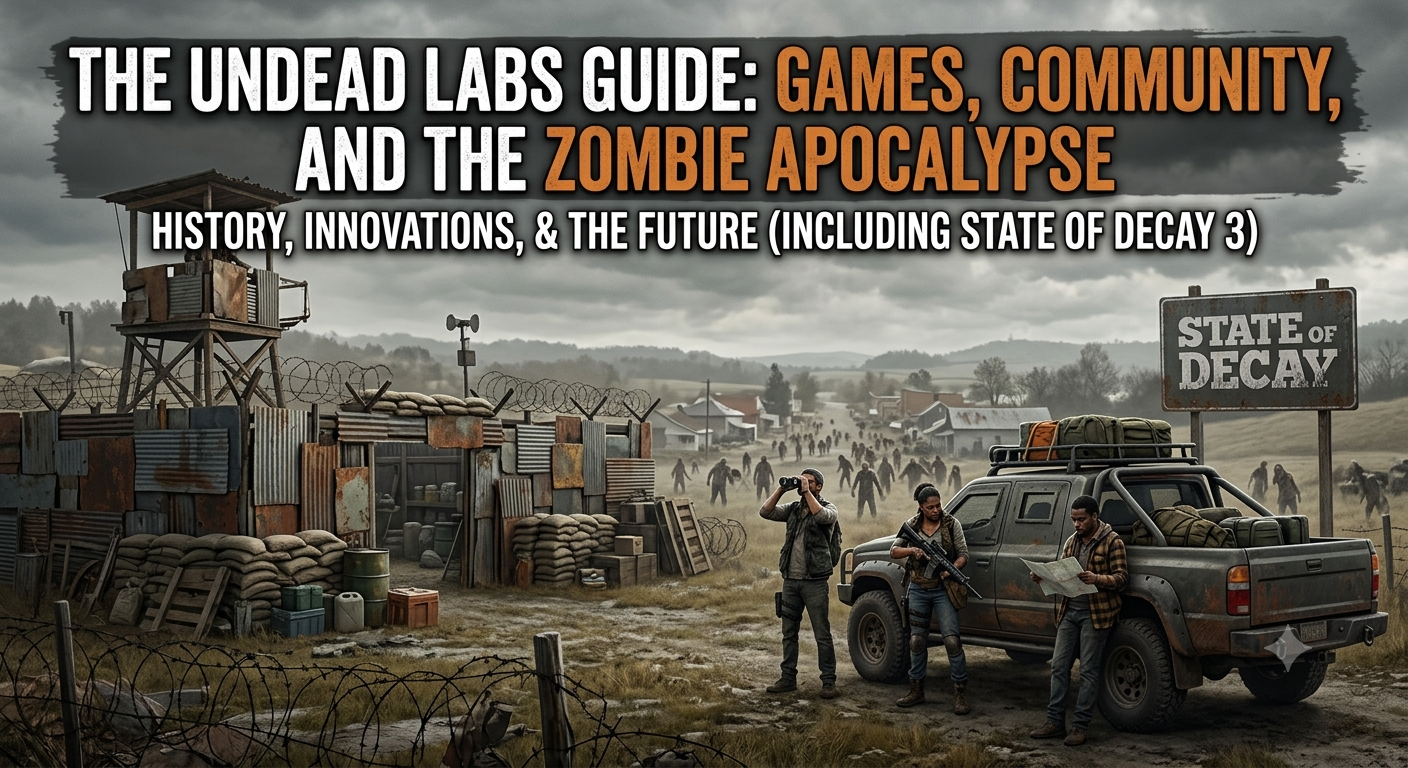
When it comes to video games centered around the zombie apocalypse genre, few development teams have as notable or influential a legacy as Undead Labs. Founded in 2009 by ArenaNet co-founder Jeff Strain, this Seattle-based developer has been quietly pioneering an entirely new kind of online zombie survival simulation. Unlike competitors that opted to focus exclusively on first-person shooter gameplay or cinematic horror themes, Undead Labs invested substantial resources into community-oriented management, permadeath mechanics, resource economy design, and base-building simulations.
Today, the company’s game catalog remains one of the deepest in terms of emergent narrative potential, creating unique apocalyptic scenarios based on the player’s actions and decisions. Microsoft-owned Undead Labs has subsequently become one of the most promising studios within the Xbox Game Studios internal ecosystem.
This guide aims to provide an in-depth overview of the entire history of games developed by Undead Labs, assess the innovations that defined their games, and outline the company’s future prospects.
The Principles of Undead Labs
Before proceeding to the chronological overview of the games developed by the team, it is necessary to describe the core design principles that allowed the developers to stand out from the competition. Undead Labs did not seek to create another first-person shooter where the protagonist would be an individually successful survivor who fearlessly charges at hordes of undead enemies. Instead, the studio’s philosophy was to simulate the dynamics of a real-life community struggling to survive in the wake of the zombie invasion.
1. Community-Driven Simulation
The games developed by Undead Labs rarely feature a single-player campaign, with survivalist narratives taking center stage instead. While the player can customize their character during the initial setup, they will subsequently serve as the leader of a broader survivor community, managing individual needs and desires. Each character has unique skills, weaknesses, personality traits, and physical appearances, which makes the potential for permanent loss deeply impactful. The games’ design philosophy subsequently emphasizes the necessity of collective survival in a hostile environment.
2. Base Construction and Resource Constraints
In the same vein, Undead Labs games are not traditional shooters, which means that the player cannot simply engage in combat. The game mechanic presupposes that the community will have limited access to resources, requiring players to scavenge supply depots, residential buildings, and other potential sources of food, water, electricity, and medical care. Furthermore, every expedition has a strategic purpose, such as obtaining construction equipment to fortify the community’s base against the advancing zombie hordes.
3. World Simulation
The game world itself is deliberately designed to be hostile and unforgiving. Most local sources of food and water are depleted, while the abundance of loud noises means that any unnecessary sound will summon legions of the undead. The vehicle physics system and maintenance mechanics are exceptionally deep, meaning that every drive consumes fuel, and every damaged system requires replacement parts to function. These seemingly tedious details create a sense of realism that has become synonymous with the franchise’s identity.

The Complete History of Undead Labs Games
Despite the studio’s overall legacy, the majority of gamers associate Undead Labs with a single title, which is State of Decay . However, there are other notable games designed by the company that either utilized different engines, adopted hybrid genres, or served as experimental proofs of concept. Below is a chronological list of all the games created by Undead Labs, beginning with the most influential title in the company’s catalog:
1. State of Decay (2013)
The first iteration of State of Decay was released on the Open 3D engine for Xbox 360 and PC, where it became a surprise hit. The title became known for its hybrid design that combined third-person shooting mechanics with strategy-driven elements. Set within the fictional Trumbull Valley, the game challenged the player to survive the zombie apocalypse as the reluctant leader Marcus Campbell. It sold over two million units across all platforms within the first two years of release, securing its place as one of the Xbox Live Arcade’s fastest-selling original titles.
- Notable Features: Interchangeable community members, fatigue mechanics, and permadeath.
- The Breakdown DLC (2013): A survival sandbox DLC that removed story progression, tasking the player with repairing the community’s escape vehicle through an escalating series of zombie encounters.
- The Lifeline DLC (2014): Changed the game’s setting to a fictional city called Danforth, which saw the introduction of the ‘Siege’ game mechanic. The player now had to lead a military unit known as Greyhound One in a defense mission.
2. State of Decay: Year-One Survival Edition (2015)
With the advent of the Xbox One platform, Microsoft requested a remaster of the original title that would include all the previously released DLCs. As a result, State of Decay: Year-One Survival Edition was born, which featured improved 1080p graphics, an enhanced physics engine, and more detailed lighting effects. It also marked the first title in the Microsoft first-party games catalog that utilized the Xbox One’s full graphical capacity.
3. Moonrise (2015)
One of the most surprising entries in the Undead Labs catalog, Moonrise was a mobile/PC multiplayer action-roleplay game that featured no zombies whatsoever. The game’s premise was to put the player in the shoes of a Warden, a specialist who defeats and subsequently trains the Solari , a unique race of creatures that can be caged and directed to attack the enemy. The title featured multiple game modes, including competitive ranked matches, creature customization, and tactical real-time battles.
Unfortunately for Undead Labs, Moonrise was canceled shortly after entering the beta testing phase due to issues with monetization. Although the game found an audience among casual gamers, it failed to achieve critical acclaim or commercial success. Nevertheless, its development provided the studio with numerous technological and design insights, including multiplayer infrastructure optimization and cross-platform optimization.
4. State of Decay 2 (2018)
Released in 2018, State of Decay 2 was the logical successor to the original State of Decay , which saw the series’ commercial performance skyrocket with each iteration. With the acquisition of the studio by Microsoft, the development of the sequel received a significant boost, including the much-requested online multiplayer mode.
State of Decay 2 offered players an expanded toolkit, including access to three large-scale maps (Cascade Hills, Drucker County, Meagher Valley), new zombie variants, Blood Plague , and the associated Plague Hearts that had to be destroyed to weaken the infected population.
5. State of Decay 2: Juggernaut Edition (2020)
In 2020, Undead Labs announced the Juggernaut Edition , which upgraded the sequel’s graphics, added a new survival sandbox mode, additional story content, and new cross-play features. The update was distributed as free downloadable content (DLC) that fundamentally changed the game, incorporating the following updates:
• A new open-world map called Providence Ridge.
• Enhanced graphical engine with improved volumetric lighting and fog effects
• New class of two-handed weapons
• Rewritten tutorial to provide a more accessible entry experience
• Cross-play features for Xbox, Microsoft Store, Epic Games Store, and Steam
The Future of Undead Labs games: State of Decay 3
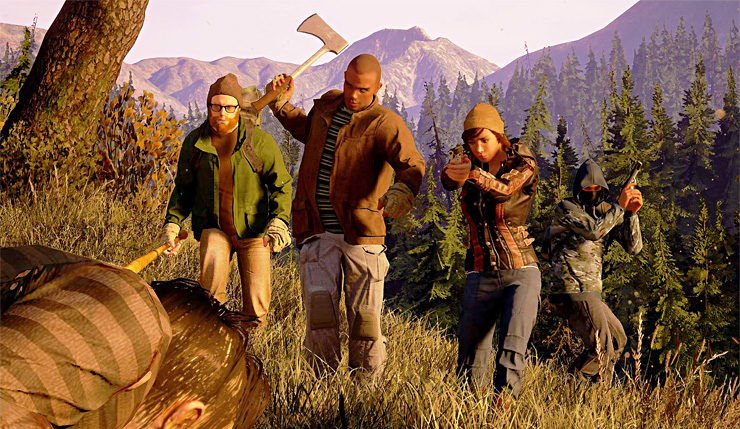
Finally, the future of the Undead Labs brand is inextricably linked with the upcoming third installment of the State of Decay survival series. First unveiled in a cinematic trailer at the end of 2020, the game has been in early access development for the past several years. With the end of 2026 rapidly approaching, the studio has since resurfaced at the June 2026 Xbox Games Showcase to share the first substantial look at State of Decay 3 gameplay in real-time.
New graphical engine
Built upon the latest Unreal Engine 5, State of Decay 3 builds upon its predecessors’ legacy, offering improved graphics while diverging from the past iteration’s unrealistic bright color palette. The game’s overall tone is darker and more realistic, with a greater emphasis on the cold, wintry landscape. According to the developers who took part in the showcase, the game’s physics and material simulation capabilities have been enhanced to allow for deeper interaction with the game world.
Key Features of State of Decay 3
| Feature | Description | Impact on Gameplay |
| Massive Open World | A map roughly four times larger than any map in State of Decay 2. | Provides true un-tethered exploration and massive strategic variety across varied biomes. |
| Persistent Shared World Co-Op | Up to 4 players share a fully synchronized, persistent save world. | Friends can build facilities, advance narrative milestones, and unlock bases together. |
| Dynamic Plague Nests | Highly advanced, evolving enemy hubs that replace standard Plague Hearts. | If left unaddressed, these nests actively expand, mutate, and send out massive assault hordes. |
| Mobile Bases | Advanced vehicle physics that allow cars to function as upgrades with deep customization options. | Vehicles can hold more cargo, use heavy armor plating, and act as remote resource depots. |
The game revolves around the ‘Maker Culture’ philosophy. Given that time has passed since the initial infection’s outbreak, the availability of top-tier equipment is severely limited. The player needs to rely on modified constructions, utilizing scrap metal, industrial machinery, and military equipment to create working prototypes.
Comparing the Pillars of the Franchise
Judging from the fundamental design principles, it becomes evident that the developers attempted to evolve the core gameplay loop with each sequel. Below is the structural progression matrix, highlighting the differences between the first three Undead Labs games:
Feature
State of Decay (2013)
State of Decay 2 (2018)
State of Decay 3 (2027)
Engine
CryEngine 3
Unreal Engine 4
Unreal Engine 5
Multiplayer
No (Single Player only)
4-Player Co-op (Guest System)
Full 4-Player Shared World Co-op
World Size
1 Map (Trumbull Valley)
5 Maps (post-update)
1 Map (4x bigger than the previous iteration)
Main Threats
Zombies and Freaks (Screamers, Ferals, Bloaters, Juggernauts)
Blood Plague Hordes, Plague Hearts, Human Settlers
Dynamic Plague Nests, Evolving Aggressive AI Hordes
Base Building
Fixed slots, limited customization
Outpost system, mod attachments, synergy bonuses
Multi-base network (up to 3 large facilities), heavy customization
Essential Game Tips for Undead Labs
The title has a steep learning curve, so it is critical to know what to do and what not to in Undead Labs. Below are some practical recommendations on getting more out of the game:
1. Know the Value of Stealth
Shooting attracts hordes of undead and hostile freaks, so it is better to engage enemies at close quarters if possible. One can utilize a crossbow and silent rifle attachments to take foes at mid-range without additional threats. Moreover, one should always equip suppressors on primary weapons to avoid detection.
2. Remember that Survivors get Tired Easily
If possible, let your community members rest after completing one or several heists. Otherwise, their stamina will deplete, preventing them from engaging in fast-paced battles. It becomes even more important when one’s survivor has to melee an aggressive Feral instead of shooting from a distance.
3. Base Construction Should Be Strategic
It is vital to build one’s base strategically, taking into account one’s survivor’s specializations and the community’s requirements. For example, if one has a Medic, one should prioritize the Infirmary to gain passive healing bonuses for the whole community. The same applies to other specialists, such as a chef, who may require a camp kitchen to prepare meals for the community.
4. Use Cars to Your Advantage
They serve as reliable transport vehicles, enabling one to carry several heavy bags of loot back to one’s base at once. Moreover, one should attempt to aim the car’s back bumper at zombies trying to board the vehicle to minimize damage to the engine.
Conclusion
From being an unknown indie developer to joining the ranks of the industry’s leading studios, such as Microsoft Xbox Game Studios, Undead Labs has demonstrated tremendous potential. The game studio has proven its ability to deliver unique titles that challenge conventional gaming genres. From the given list of games, it becomes evident that the developers are committed to creating complex sandbox games with extensive management and survival simulation systems.
Undead Labs games differ from conventional shooters in that they test the player’s planning, management, and even emotional intelligence skills rather than aiming or combat prowess. With the release of State of Decay 3 approaching in 2027, the studio promises to continue emphasizing community survival and apocalyptic terror as the core gameplay mechanics, ensuring that Undead Labs retains its status as one of the most anticipated game studios for years to come.
Frequently Asked Questions (FAQs)
What was the first game developed by Undead Labs?
The first video game developed by the studio was State of Decay, which was published on Xbox Live Arcade in June 2013 for the Xbox 360 console and later released on personal computers.
Are there any non-zombie-related games developed by Undead Labs?
In 2015, the company announced the creation of a multiplayer monster-training tactical role-playing game entitled Moonrise . It was released in a beta version for mobile devices and PC via Steam but was eventually canceled before its commercial launch.
When was State of Decay 3 released?
After the game’s public gameplay showcase at the Xbox Games Showcase in June 2026, it is scheduled to be released in 2027. It will become available on Windows PC, Xbox Series X/S consoles, and PlayStation 5 at launch and join the Xbox Game Pass subscription service.
Can you play Undead Labs games in single-player mode?
Yes, most games developed by Undead Labs offer a single-player campaign where the player manages the community and switches between different characters.
Why does the game feature permadeath?
The game’s permadeath mechanics enable players to experience the loss of community members and make one’s actions in the game meaningful.